

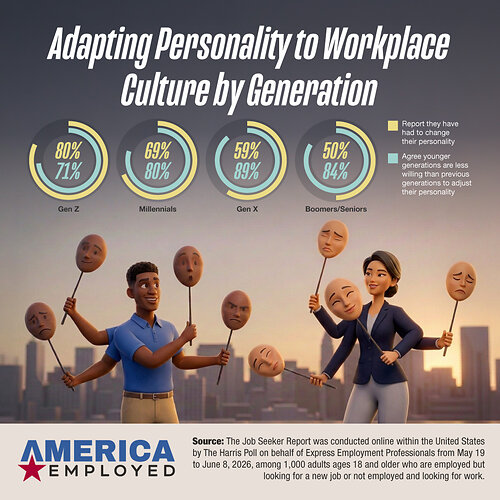
Job seekers say adapting their personality to fit workplace culture is important, but more than half call the expectation unfair. Despite perceptions about younger workers, Gen Z and millennials report adapting the most, according to a recent Express Employment Professionals-Harris Poll survey.
For many, adapting is already part of the job. Two-thirds of job seekers (67%) have changed aspects of their personality to fit workplace culture, while 63% say their personality at work is very different from who they are in everyday life.
More than 4 in 5 job seekers (86%) say adapting their personality to workplace culture is now considered a core professional skill, while 83% believe employees who are unable or unwilling to adjust may not stay with a company as long.
Personality also factors into how employees are evaluated and whether they advance. Nearly all hiring managers (94%) and job seekers (91%) say it shapes perceptions of performance, while 99% of hiring managers and 90% of job seekers believe a positive or approachable personality can accelerate career advancement.
Yet many job seekers question whether personality should carry that much weight. More than half (56%) say it has nothing to do with their work or ability to do the job, including 71% of Gen Z, 54% of millennials, 51% of Gen X and 36% of baby boomers and seniors.
That clashes with a common perception: Most job seekers believe younger employees are less willing than previous generations to change their personalities to fit in at work.
Workplace Guidance Has Not Kept Pace
Despite the pressure to adapt, only half of job seekers (50%) say their company provides guidance on managing or developing their personality for a professional setting. Millennials (59%) and Gen Z (58%) are more likely to receive that support than Gen X (39%) and baby boomers and seniors (30%).
Job seekers said personality differences can shape how teams function, particularly under pressure. One respondent said a calm and organized approach helped reduce stress during tight deadlines, allowing the team to collaborate and stay focused.
Others described how difficult interactions can take a toll. One job seeker said a defensive teammate made colleagues reluctant to offer feedback and slowed decisions, while another recalled an "extremely demanding and overbearing" colleague whose behavior contributed to several employees leaving.
"Workplace culture should set expectations for how people treat one another, not prescribe who people have to be," said Bob Funk Jr., CEO, president and chairman of Express Employment International. "Shared values give people a foundation for how they work together while still allowing room for different personalities and ways of working. That requires flexibility from employers and employees alike. When both sides approach the workplace with respect and a willingness to adapt, people can be themselves while contributing to a culture where everyone can succeed."