
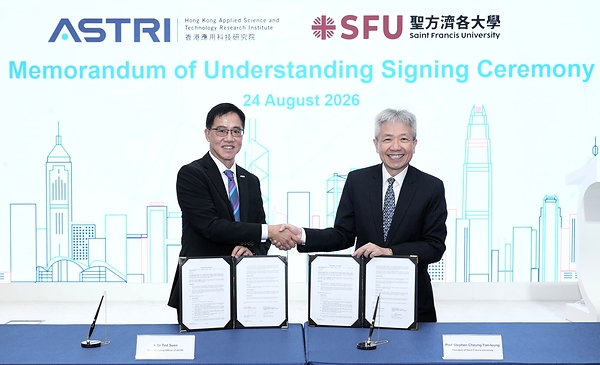
The Hong Kong Applied Science and Technology Research Institute (ASTRI) and Saint Francis University (SFU) have signed a Memorandum of Understanding (MoU) to establish a strategic partnership focused on advancing research and development in AI-enabled biomaterials and digital health technologies. The collaboration aims to accelerate innovation, facilitate technology transfer, and nurture the next generation of talent in applied sciences.
The MoU was signed by Ir Dr Ted Suen, Chief Executive Officer of ASTRI, and Professor Stephen Cheung Yan-leung, President of Saint Francis University.
Ir Dr Ted Suen said, "We are delighted to partner with Saint Francis University to advance innovation in AI-enabled biomaterials and digital health. This collaboration exemplifies both institutions' shared commitment to applied research that translates into tangible solutions addressing real-world societal challenges. By combining ASTRI's R&D capabilities with SFU's academic strengths, we can drive innovation across healthcare, smart city applications, education technology, elderly care, and more, whilst nurturing the diverse talent pipeline essential for Hong Kong's development as an international innovation and technology hub."
Professor Stephen Cheung Yan-leung said, "This partnership between SFU and ASTRI will leverage their respective strengths in applied research, artificial intelligence, and health sciences. As Hong Kong's largest tertiary institution for registered nurse training, SFU offers not only nursing programmes but also programmes in physiotherapy, pharmaceutical studies, and community health. This collaboration will further drive the integration and application of AI in health sciences and related professional services. SFU is also committed to advancing AI education and research. Through this partnership, we aim to explore AI applications in digital health, elderly care, medical support, and special educational needs, uniting technology with professional expertise to meet the changing demands of society."
Under the agreement, the two institutions will collaborate across three key pillars: joint research and development, technology transfer and commercialisation, and talent development.
Joint R&D in AI-Enabled Biomaterials & Digital Health
The partnership will focus on co-developing AI-driven biomaterial design platforms that integrate machine learning with material science to accelerate the discovery and optimisation of biocompatible materials for medical applications. Research initiatives will include nano-biomaterial-based diagnostic and therapeutic solutions, such as targeted drug delivery systems, bio-sensing platforms, and biodegradable implants, paired with AI algorithms for real-time patient monitoring and personalised treatment adjustment.
The collaboration will also extend to AI-powered solutions for digital health, elderly care, special educational needs (SEN) support, smart city applications, and educational technology. Both parties will jointly submit research proposals to government funding schemes, industry sponsorship programmes, and regional innovation grants.