
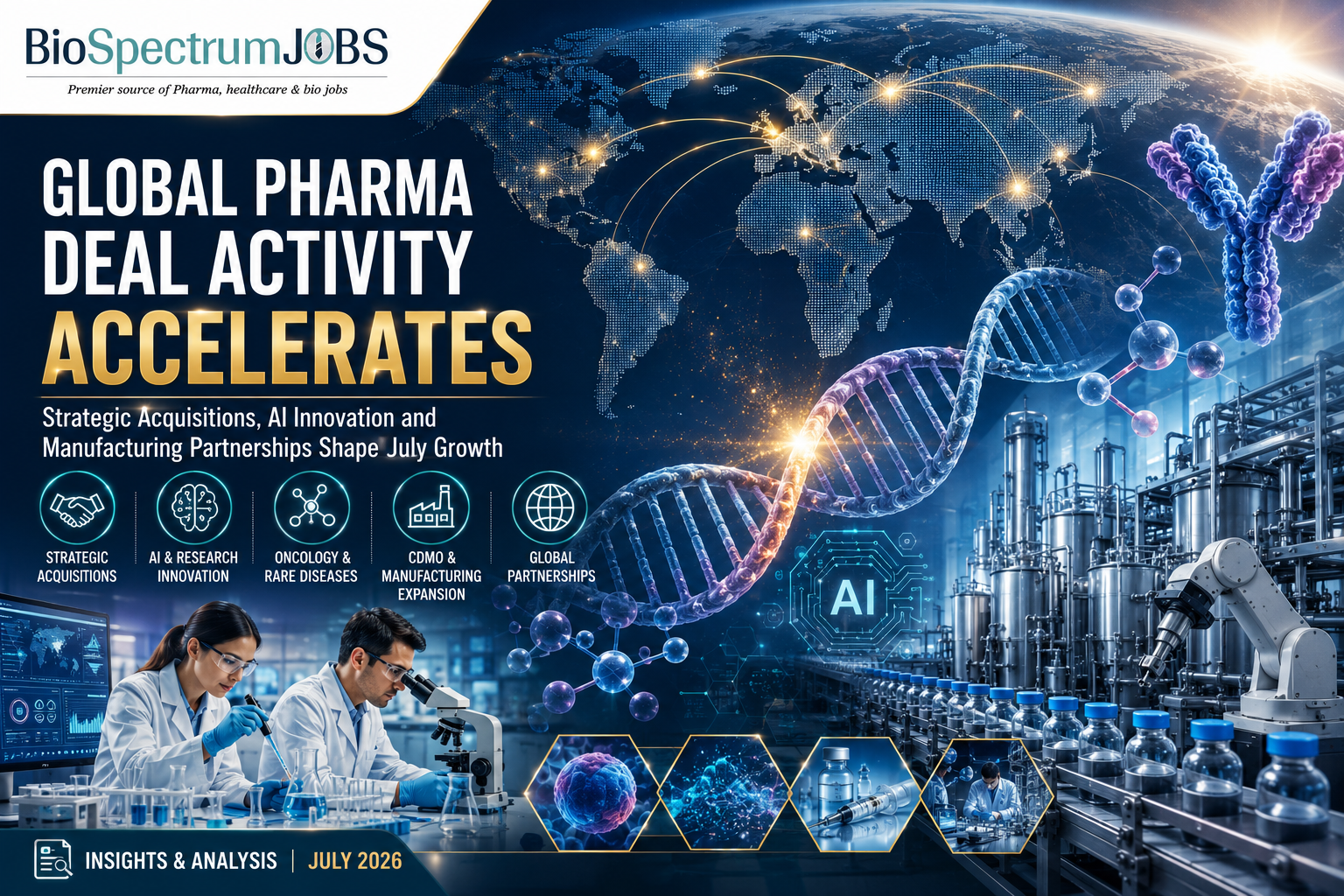
The pharmaceutical industry's transformation continued at pace in July as companies embraced strategic collaborations to navigate an increasingly competitive innovation landscape. Rather than relying solely on internal research and development, biopharma leaders demonstrated a clear preference for acquiring specialised technologies, licensing promising assets, expanding manufacturing networks, and forging research alliances that accelerate the journey from discovery to commercialisation.
One of the defining characteristics of July's deal activity was the continued dominance of mergers and acquisitions aimed at strengthening therapeutic pipelines and expanding technology platforms. Large pharmaceutical companies increasingly targeted specialised biotechnology firms to secure differentiated assets in oncology, neurology, rare diseases and cell therapy, highlighting the industry's appetite for innovative late-stage programmes with strong commercial potential.
Servier significantly expanded its rare neurology portfolio through the completion of its acquisition of Edgewise Therapeutics' muscular dystrophy business, adding the late-stage investigational therapy sevasemten for Becker and Duchenne muscular dystrophy. Likewise, Eli Lilly strengthened its neuroscience ambitions through the acquisition of AtaiBeckley, gaining access to next-generation therapies designed to address treatment-resistant depression and other serious mental health conditions.
Oncology Innovation
The oncology sector remained the primary catalyst for deal-making. Novartis moved to strengthen its antibody-drug conjugate (ADC) portfolio through the acquisition of UK biotechnology company Myricx Bio, whose novel payload technology has the potential to overcome limitations associated with existing ADC therapies. Ipsen also reinforced its rare disease strategy by acquiring Memo Therapeutics, securing potravitug, a promising Phase II antibody therapy targeting BK polyomavirus-associated nephropathy in kidney transplant patients. Medtronic's acquisition of SPR Therapeutics further reflected growing investment in innovative treatment modalities, expanding its neuromodulation portfolio for chronic and acute pain management.
Manufacturing capabilities also became strategic acquisition targets. Samsung Biologics launched its acquisition bid for peptide specialist PolyPeptide Group, seeking to diversify beyond monoclonal antibodies and antibody-drug conjugates into one of biopharma's fastest-growing therapeutic segments. Similarly, Repligen announced a $1.5 billion acquisition of BioLife Solutions, strengthening its position in cell and gene therapy manufacturing technologies while expanding its portfolio of critical bioprocessing solutions.
While acquisitions continued to reshape competitive positioning, licensing agreements emerged as an equally powerful strategy for accelerating global commercialisation. Rather than building regional infrastructure independently, companies increasingly leveraged partnerships that combined innovative pipelines with established commercial expertise.
AstraZeneca's exclusive licensing agreement with Dizal Pharmaceutical for Zegfrovy represents a significant expansion of its lung cancer portfolio, reinforcing the company's leadership in EGFR-mutated non-small cell lung cancer. IMPACT Therapeutics similarly broadened the global reach of its ovarian cancer therapy senaparib by granting Pharmanovia exclusive rights across Europe, the Middle East, North Africa, Australia and New Zealand in a transaction valued at up to €423.5 million.
Cross-border collaboration also gained momentum in Asia. Kaigene partnered with Japan's Taisho Pharmaceutical to commercialise its autoimmune therapy KG006 while complementing its broader global alliance with Celltrion. Cadila Pharmaceuticals entered a strategic joint venture with Singapore-based Wellesta Holdings to expand access to prescription medicines, consumer healthcare products and specialty therapies across Southeast Asia, illustrating how regional alliances continue to drive market expansion.
Beyond licensing, pharmaceutical companies increasingly recognised that innovation depends on collaboration across academia, biotechnology, artificial intelligence and manufacturing. July witnessed a notable surge in partnerships focused on next-generation drug discovery technologies, with artificial intelligence becoming a central component of pharmaceutical research strategies.
Insilico Medicine stood at the forefront of this trend through two significant alliances. Its collaboration with Takeda aims to accelerate discovery of clinically differentiated drug candidates using its proprietary Pharma.AI platform, while a separate partnership with Bora Pharmaceuticals integrates AI-powered molecule design with advanced manufacturing and commercial capabilities. Together, these agreements demonstrate how AI is evolving from a discovery tool into an integrated platform supporting the entire drug development continuum.
Similarly, Harbour BioMed partnered with China's Sinopharm to establish an Innovation Consortium dedicated to advancing biologics research by combining fully human antibody technology with AI-enabled drug discovery capabilities. Singapore's A*STAR and CuspAI announced a five-year partnership designed to accelerate materials discovery through the integration of artificial intelligence, autonomous laboratories and advanced materials science. These collaborations signal a broader shift towards digitally enabled pharmaceutical innovation, where AI increasingly complements scientific expertise rather than replacing it.
Research partnerships also extended into specialised therapeutic areas. Charles River Laboratories collaborated with Arovella Therapeutics to support next-generation sequencing services for cell therapy development, while Nona Biosciences and Lonza joined forces to develop blood-brain barrier-crossing antibody technologies capable of transforming central nervous system drug delivery. OTR Therapeutics partnered with LG Chem to accelerate oncology asset development from China, highlighting continued interest in cross-border innovation ecosystems.
Manufacturing investment remained another defining trend throughout July, as companies sought to strengthen supply chain resilience while supporting growing biologics demand. Lonza expanded its strategic biologics manufacturing collaboration with a leading US biopharmaceutical company, reinforcing its long-term position as one of the world's premier CDMOs. AGC Biologics entered a partnership with Pyramid Pharma Services to deliver integrated drug substance and sterile fill-finish manufacturing within the United States, reflecting growing demand for end-to-end domestic production capabilities.
Codis expanded its European footprint through the acquisition of Catalent's Nottingham facility, strengthening its expertise in spray drying and oral solid dosage development. Meanwhile, Evonik announced a $100 million investment to modernise its Indiana drug substance manufacturing site, positioning the company to meet rapidly increasing demand for US-based CDMO services.
Supporting infrastructure also attracted investment. Ember LifeSciences partnered with Japan's Alfresa Corporation to strengthen pharmaceutical cold chain logistics, while Excedr secured $25 million to expand laboratory equipment financing for biotechnology companies. Together, these investments demonstrate that pharmaceutical innovation increasingly depends on the broader ecosystem supporting research, manufacturing and commercial operations.
July's deal activity ultimately reflects a pharmaceutical industry becoming more collaborative, technologically integrated and globally connected. Companies are no longer pursuing isolated transactions but building interconnected ecosystems that combine scientific innovation, digital technologies, manufacturing excellence and commercial expertise. Whether through billion-dollar acquisitions, AI-enabled research collaborations or strategic manufacturing partnerships, organisations are prioritising speed, flexibility and global reach to address increasingly complex healthcare challenges.
As biologics, precision medicine, artificial intelligence and advanced manufacturing continue reshaping the competitive landscape, strategic partnerships will remain fundamental to future growth. July's transactions demonstrate that the industry's next wave of innovation will be driven not only by breakthrough science but also by the strength of collaborative networks capable of translating discovery into meaningful patient outcomes worldwide.