

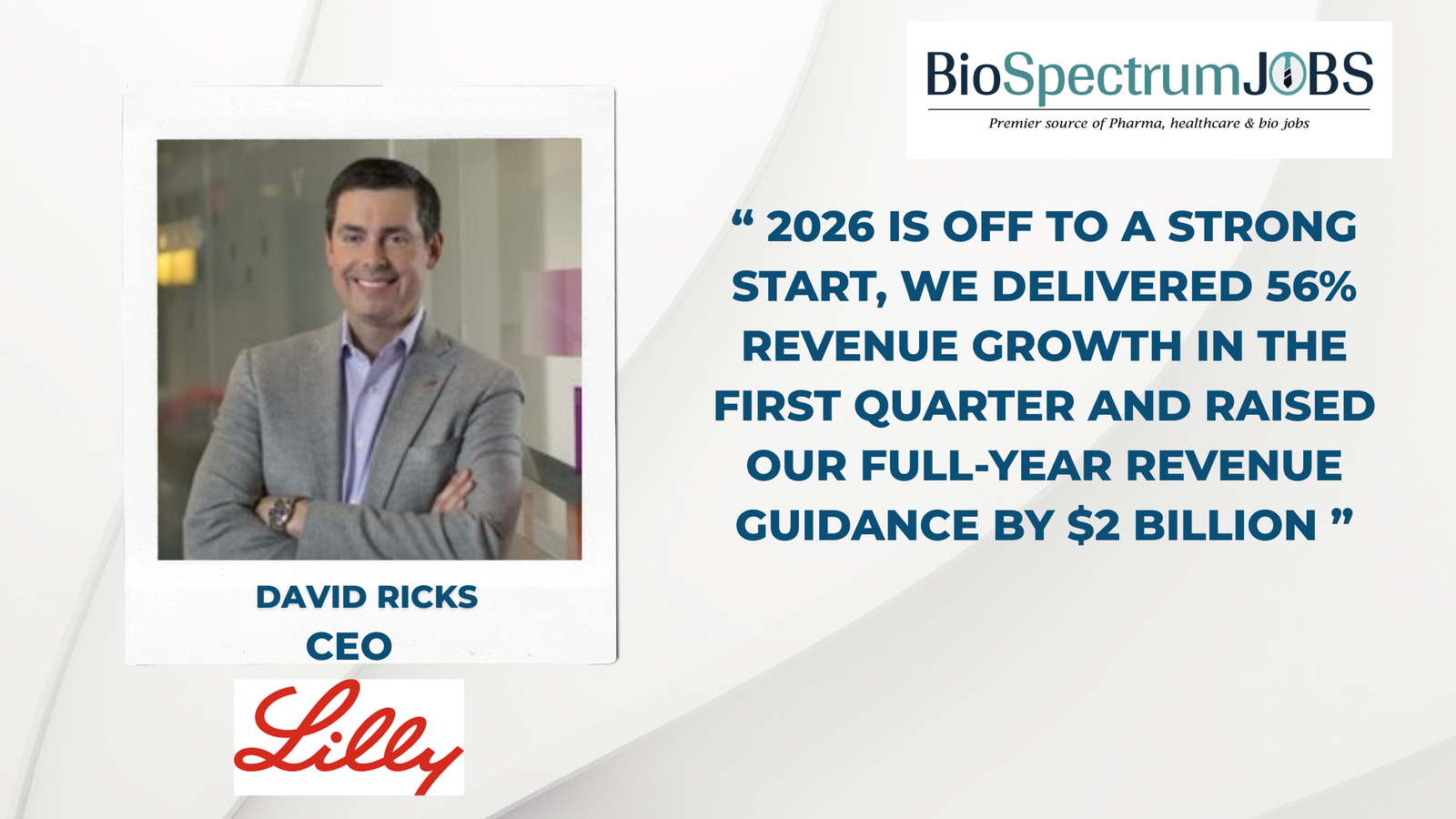
Eli Lilly and Company reported a strong start to 2026, delivering exceptional first-quarter financial performance driven by sustained global demand for its cardiometabolic portfolio. The company posted revenue of $19.8 billion in Q1 2026, representing a 56% year-over-year increase, supported primarily by significant volume growth across key products.
Net income rose sharply to $7.4 billion compared to $2.8 billion in the same period last year, while reported earnings per share (EPS) climbed 170% to $8.26. On a non-GAAP basis, EPS reached $8.55, reflecting a 156% increase, significantly outperforming market expectations.
CEO David Ricks described the quarter as a “strong start to 2026,” emphasizing broad-based growth across the company’s portfolio and reaffirming confidence in long-term demand drivers, particularly within the GLP-1 franchise.
Blockbuster GLP-1 Portfolio Drives Growth
The company’s performance was overwhelmingly driven by its incretin-based therapies, particularly Mounjaro and Zepbound.
- Mounjaro generated $8.7 billion in global revenue, marking a 125% year-over-year increase
- Zepbound delivered $4.1 billion in U.S. sales, up 80% year-over-year
Combined, these products contributed the majority of Lilly’s growth, reflecting robust demand across both diabetes and obesity indications. Notably, volume growth reached 65% overall, although partially offset by a 13% decline in realized prices due to rebates and pricing dynamics.
International markets emerged as a major growth engine, with revenue outside the U.S. rising 81% to $7.7 billion, driven by strong uptake of Mounjaro, including its inclusion in China’s National Reimbursed Drug List.
Diversified Portfolio Gains Momentum
Beyond cardiometabolic therapies, Lilly reported strong growth across immunology, oncology, and neuroscience, with key product revenue in these segments increasing 160% year-over-year.
Emerging therapies such as Jaypirca, Ebglyss, and Kisunla contributed to this expansion, reflecting the company’s continued pipeline diversification strategy.
Additionally, Lilly’s newly approved oral GLP-1 therapy, Foundayo, marks a significant milestone in expanding treatment accessibility. The pill format is expected to broaden patient adoption, particularly among individuals hesitant to use injectable therapies.
Investment in Innovation and Commercial Expansion
To sustain its growth trajectory, Lilly increased research and development (R&D) spending by 28% to $3.5 billion, underscoring its commitment to advancing both early- and late-stage pipeline assets.
Marketing, selling, and administrative expenses also rose 19% to $2.9 billion, reflecting intensified promotional efforts supporting recent and upcoming product launches.
Despite these investments, gross margin remained strong at 81.9%, although slightly impacted by pricing pressures across key products.
Raised Full-Year 2026 Guidance
Buoyed by strong first-quarter performance, Lilly raised its full-year 2026 outlook:
- Revenue guidance increased to $82–$85 billion
- Adjusted EPS forecast raised to $35.50–$37.00
The revised guidance reflects continued confidence in the scalability of its GLP-1 portfolio and expanding global access. Analysts note that demand for obesity and diabetes treatments remains a key structural growth driver for the company.
Strategic Outlook
Looking ahead, Lilly is well-positioned to maintain its leadership in the rapidly expanding obesity and diabetes markets. The company’s dual focus on innovation and commercial execution—supported by continued investments in R&D, global market expansion, and new product launches—provides a strong foundation for sustained growth.
CEO David Ricks emphasized that pricing adjustments, while impacting margins, are enabling broader patient access and driving significant volume expansion—a trend expected to continue supporting long-term revenue growth.