

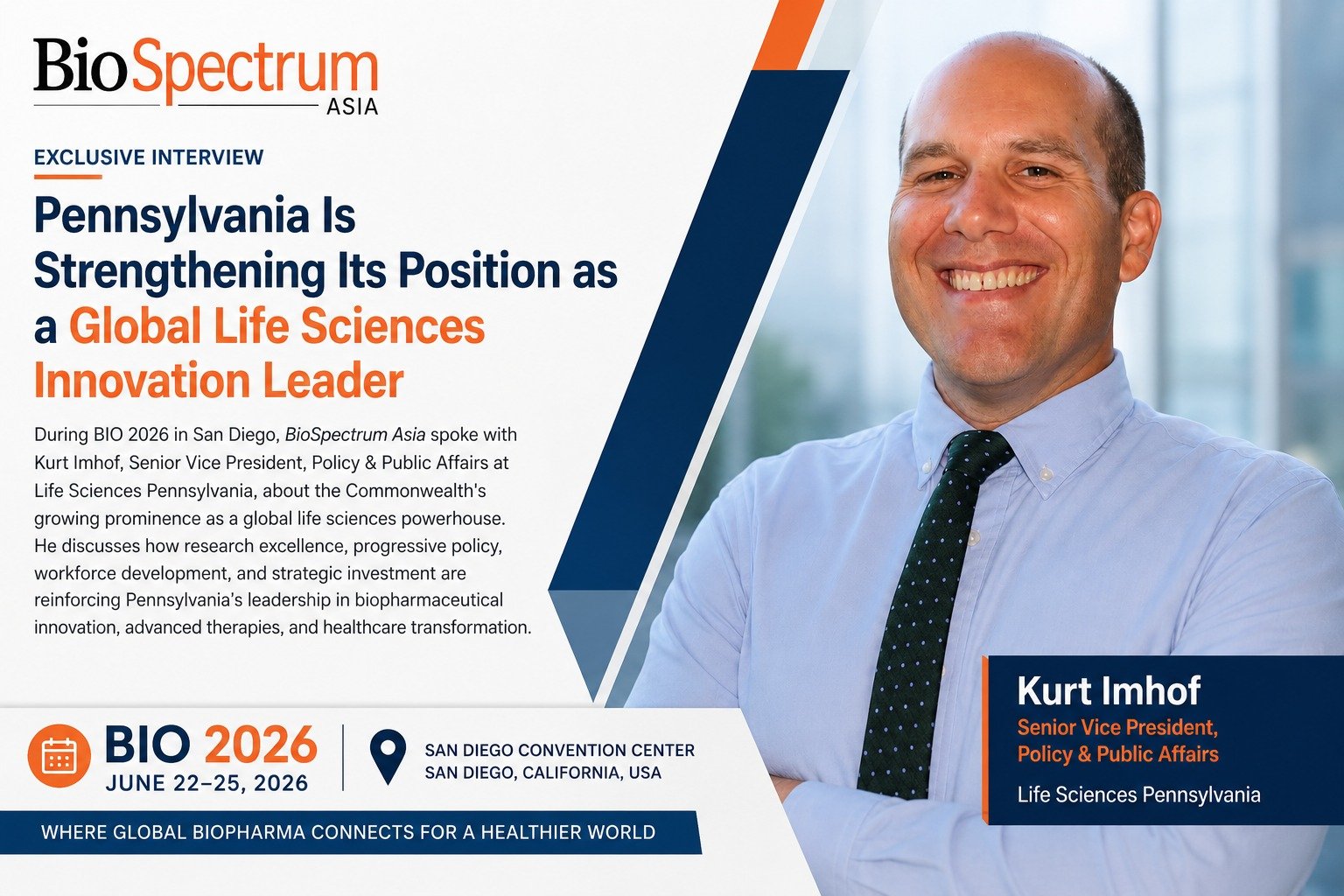
At BIO International Convention 2026, Kurt Imhof, Senior Vice President, Policy & Public Affairs at Life Sciences Pennsylvania, discusses how research excellence, progressive policy, workforce development and leadership in advanced therapies are reinforcing Pennsylvania's position as one of the world's premier life sciences ecosystems.
During BIO 2026 in San Diego, BioSpectrum Asia spoke with Kurt Imhof, Senior Vice President, Policy & Public Affairs at Life Sciences Pennsylvania, about the Commonwealth's growing prominence as a global life sciences powerhouse. He discusses how research excellence, progressive policy, workforce development, and strategic investment are reinforcing Pennsylvania's leadership in biopharmaceutical innovation, advanced therapies, and healthcare transformation.
Pennsylvania continues to attract significant life-sciences investment. What factors are underpinning this momentum?
There are several items that keep Pennsylvania’s life sciences economy growing…First, the state’s strong academic research institutions continue to attract significant federal funding for early-stage, foundational scientific research. Second, the state is home to a strong cross-section of global pharmaceutical and medical device and diagnostics manufacturers, contract research organizations, and supply chain entities, among others, that employ a similarly diverse and talented workforce. Third, the state is home to a robust clinical trial continuum with academic research institutions, affiliated health systems and biopharmaceutical companies sponsoring significant clinical trial activity in the commonwealth.
How are policy frameworks influencing the state's competitiveness in biopharmaceutical innovation and manufacturing?
For the first time in more than two decades Pennsylvania’s Governor put forth an economic development plan, which included life sciences as one of its pillars for growth. That emphasis on the life sciences sector has led to this administration being very proactive in marketing the state’s life sciences ecosystem. Couple that with establishment of an “Office of Transformation and Opportunity” and a more robust business attraction team and we’ve seen several significant investments (Eli Lilly, TerraPower Isotopes, and Johnson & Johnson) announced this year. That said, there are additional steps the Pennsylvania General Assembly, in cooperation with the Governor, can take to advance the life sciences economy – such as passing the Governor’s $100 million ‘Innovate in PA 2.0’ proposal.
What role will workforce development play in sustaining future industry growth?
Pennsylvania has approximately 109,000 individuals directly employed by the life sciences industry, and has a breadth of talent across life sciences specialities – manufacturing, supply, and scientific/clinical/research talent. In fact, Pennsylvania consistently graduates a significantly high number of degrees in both the overall life sciences field and the biological and biomedical sciences subset. Where Pennsylvania could utilize assistance is in executive level talent to lead companies and attract capital. Additionally, and we’ve seen this begin to take shape, it will be important for Pennsylvania public and private entities to work collaboratively to ensure there is a talent pipeline for sustained life sciences manufacturing growth.
How do you see Pennsylvania's position evolving within the broader US and global life-sciences landscape?
I believe Pennsylvania is well positioned for continued growth domestically and internationally. Pennsylvania has a clear leadership role in advanced therapies, such as cell and gene therapy; Pittsburgh in particular is a pioneer in the field of AI, robotics and data driven healthcare; and have an outsized influence in pandemic and public health preparedness. In fact, Pennsylvania is home to the first FDA-approved gene therapy for an inherited disease, the first FDA-approved redosable gene therapy, the first FDA-approved CAR T cell therapy, and is home to two researchers who pioneered (and subsequently received the Nobel prize) the science behind mRNA vaccine development. Finally, the BIO 2027 Convention returning to Pennsylvania (and Philadelphia in particular) is an acknowledgement of the state’s important position in the global life sciences ecosystem.
Which policy or regulatory developments should industry leaders monitor most closely over the next few years?
As uncertainty continues at the federal level, it’s important Pennsylvania continue to act as a stabilizing agent for the life sciences ecosystem. Among other things, Pennsylvania is working to expand its Research & Development Tax Credit (which, unlike most states, can be sold by non-revenue companies to raise early stage capital), create a statewide clinical trial network that will leverage its research and clinical care leadership to encourage companies to conduct clinical trial work(and locate) in the state, and match federal dollars like Small Business Innovation Research (SBIR)/Small Business Technology Transfer (STTR) grant funding.
By Ankit Kankar